
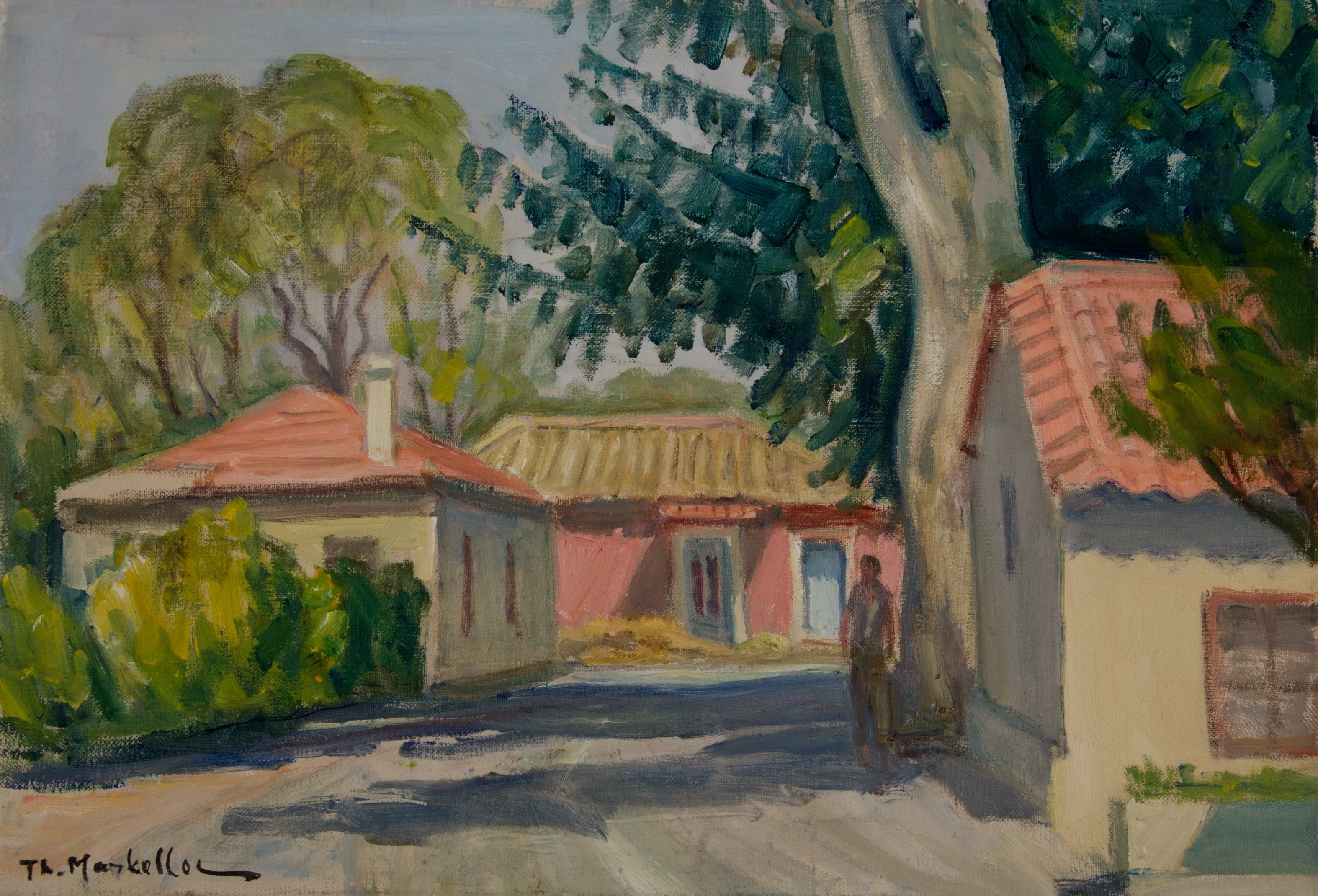
Red House, Nerantza
M2355
About This Work
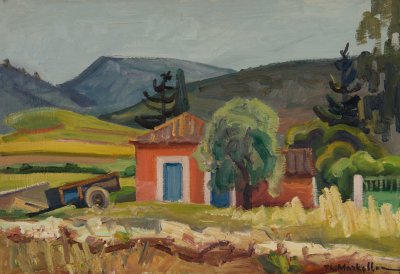
In Nerantza, a red house commands the composition—its saturated facade the sole chromatic intensity against muted ochres and field greens.
A red house stands slightly off-center in the Greek countryside, anchoring a sunlit landscape of quiet presence. The composition unfolds horizontally, guiding awareness from foreground terrain through local vegetation toward the central dwelling. Its bold red surface contrasts with surrounding earth tones—ochres, soft greens, and warm greys—characteristic of rural Nerantza. Rooflines and pathways suggest subtle linear perspective, reinforcing a grounded, observational stance. The work combines impressionistic handling with realist intent, where brushwork shifts between smooth sky gradients and textured stucco walls, leafy details built with deliberate impasto. Cooler shadows beneath eaves offset sun-warmed planes, adding dimension without stylization. Distant hills fade softly, enhancing spatial depth while keeping focus on the house itself. Absent of figures, the scene emphasizes place over narrative, evoking cultural rootedness and quiet domesticity in vernacular form. The painting captures a moment of stillness in rural life—neither bustling nor abandoned, but enduring. This specificity of location grounds the work in geographic authenticity, suggesting a travel-inspired impulse to honor ordinary dwelling and landscape together. Medium appears to be oil or acrylic on canvas, suited to the dimensional variation across surfaces. The overall mood aligns with broader traditions of 20th-century European landscape painting that seek poetic resonance in humble locales. There exists a palpable Mediterranean luminosity throughout—midday clarity or late-afternoon warmth without dramatic contrast—that fosters nostalgic reverence and peaceful observation. The red house reads as a beacon of human continuity within a tranquil setting, a marker of presence rather than intrusion. Stillness settles over the red house and its surroundings with the weight of afternoon light.
Related paintings
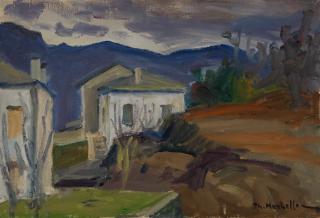 Zagora, House Above the Hotel
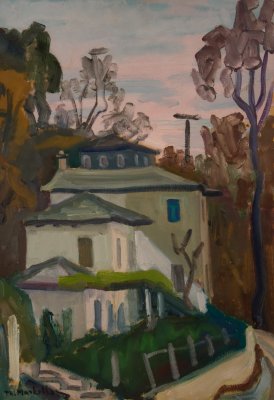 Pouri
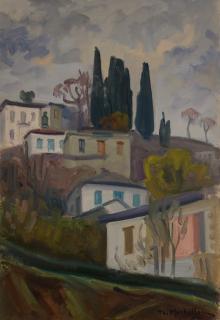 Zagora Sunset with Cypresses
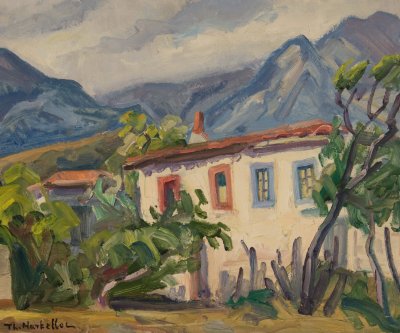 Daulia House with Parnassus in Background
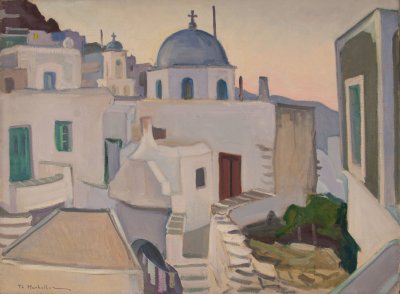 Nios from My House Steps at Dusk
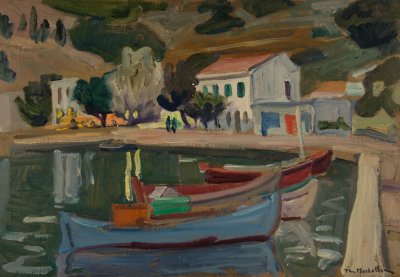 Alonissos Harbor, Evening
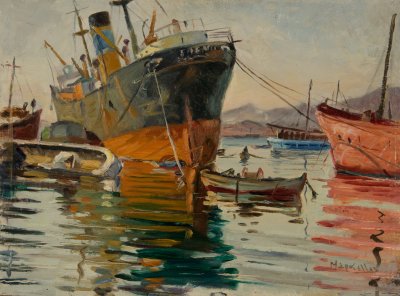 Perama, Ship Moored at Sea
 Street in Leonidio
 Nerantza Beach with Many People
 Makrinitsa from My Doorstep
 Paros, Houses, Sea Beyond
 Landscape in Marathon