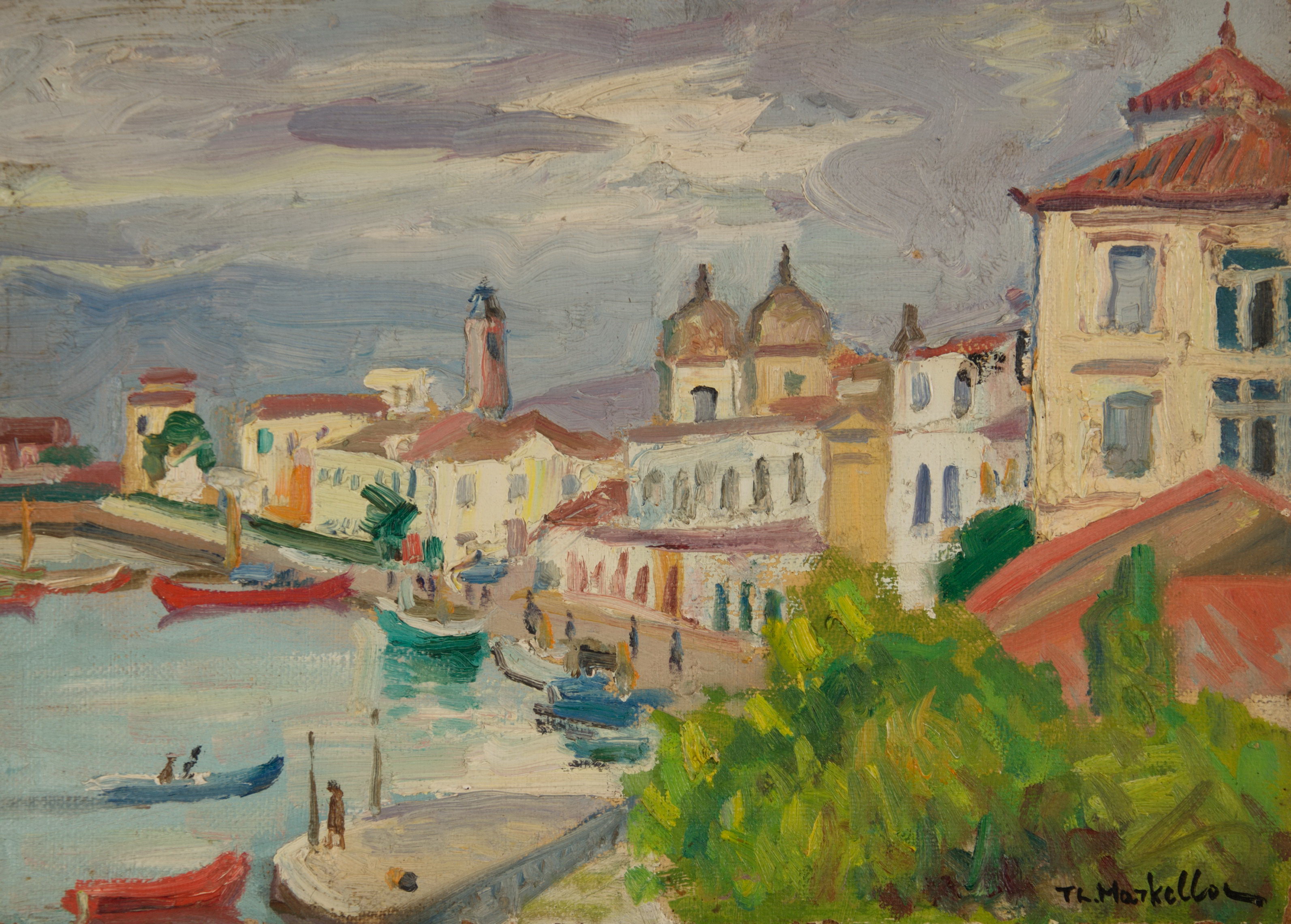
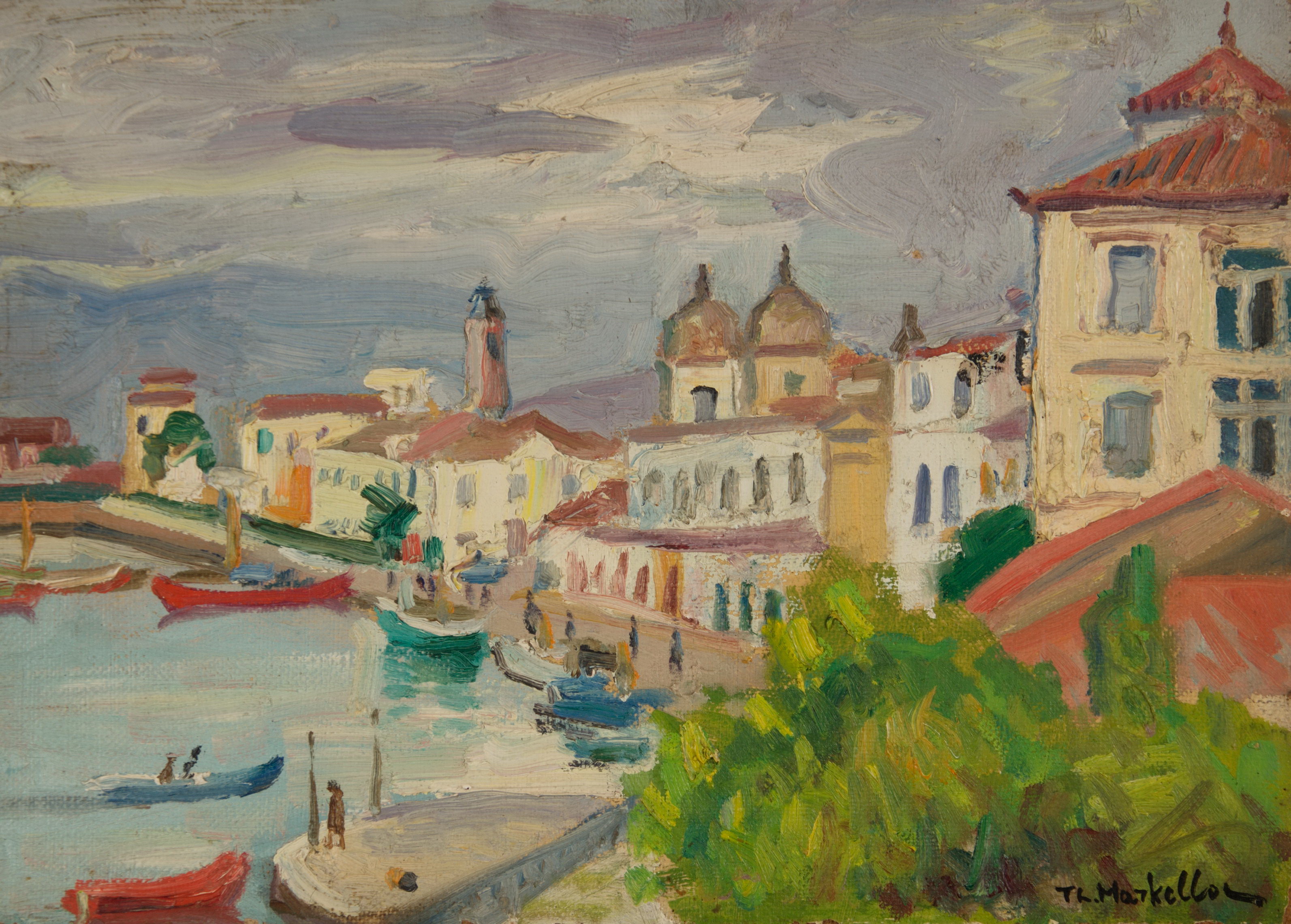
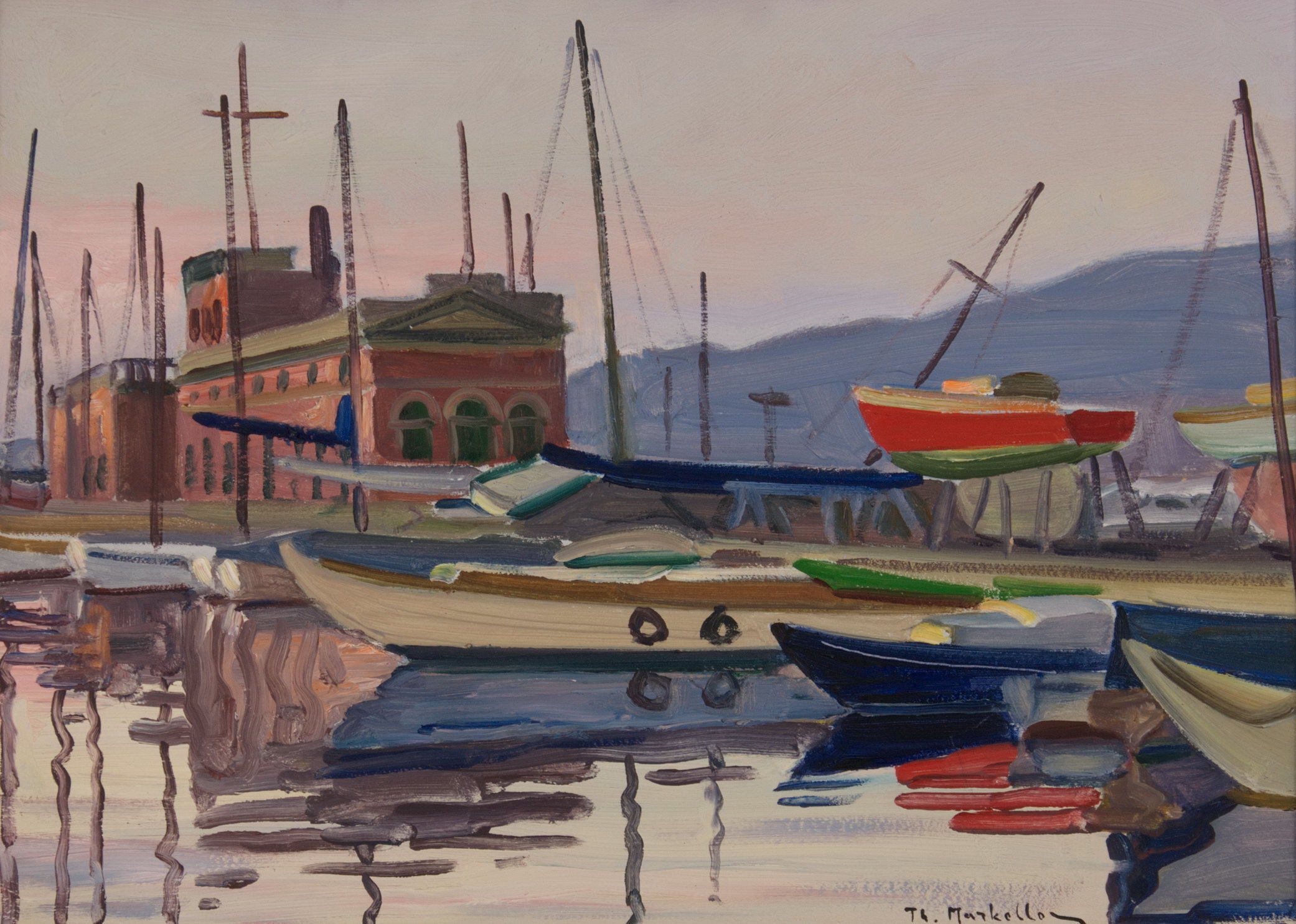
From a hotel window above the Euboean strait, light settles across still water with the quiet authority of midday. Architectural fragments — a railing, a mullion, the geometry of a room's edge — hold the viewer in place, as if caught in a moment of private looking. Below, moored boats sit motionless on a surface that mirrors sky and shore in equal, unhurried measure.
The Painting — Chalkida, Harbor from Hotel
The scene unfolds from an elevated interior vantage point, the viewer positioned behind what appear to be balcony railings or window frames that divide the foreground into calm verticals. Beyond them, a waterfront recedes diagonally toward a far shore where low-rise buildings and soft hills dissolve into Mediterranean atmosphere. The composition is organized by strong linear perspective, yet nothing feels rigid — the lines serve the light rather than contain it.
In the midground, simplified boat hulls and masts punctuate the quayside without demanding precise attention. Markellos renders them as presences rather than portraits: enough form to convey weight and stillness, not enough detail to distract from the broader tonal unity of the scene. The water beneath them is calm, its surface carrying faint reflections of the opposite shore — ochres, chalky whites, muted blues — blurred just enough to suggest depth without drama.
The palette moves through warm earth tones and tempered blues, with sunlit façades rendered in creamy impasto that catches the eye before releasing it to the softer passages of sky and water. Paint application varies deliberately: thin washes model the strait's surface, while thicker, more textured strokes define the sunlit planes of buildings across the harbor. The result is a surface alive with tactile variation — particularly remarkable given the work's intimate scale of 33 × 46 cm, executed in oil on fiberboard.
Shadows are short and crisp, implying a specific midday hour, yet the overall light feels diffuse rather than theatrical. There is no dramatic chiaroscuro here, no orchestrated contrast. Instead, Markellos pursues atmospheric unity — a condition of light in which everything is equally, quietly present.
A Painter of Observed Light
Theodoros Markellos spent his life — from 1925 to 2015 — working from direct observation of the world around him. Across a body of more than 750 works, he returned repeatedly to harbors, coastlines, and the particular quality of light that falls on water near the Greek mainland. The Chalkida painting belongs to this sustained engagement with coastal topography, where the subject is never merely a location but always a condition: how light behaves at a specific hour, how stillness can be made to feel inhabited rather than empty.
What distinguishes this work within that broader practice is its vantage point. Rather than positioning the viewer at quayside level — immersed in the harbor's activity — Markellos places us above and behind the architecture of the hotel itself. The interior frame becomes part of the composition. We are observers, not participants, and that distinction shapes everything: the mood of quiet remove, the sense of a suspended afternoon, the feeling that the scene beyond the window is being held rather than approached.
Among his Greek contemporaries, Markellos maintained a commitment to representational, volumetric, atmospheric painting at a time when abstraction and decorative figuration claimed significant attention. Works like this one — grounded in direct observation yet shaped by a refined sense of chromatic and tonal harmony — reflect that sustained artistic position. You can see more paintings from his coastal work in the full gallery, or read about how this work relates to comparable harbor compositions in the collection.
Looking Closer — The Foreground Frame
The most quietly decisive element of this composition is what is closest to us: the architectural framing of the foreground. Railings or window mullions — their exact identity left pleasingly ambiguous — divide the picture plane into vertical intervals before the eye moves outward to the water. This device is not merely structural. It creates a layered sense of pictorial space that draws the viewer into the image progressively, from the immediate interior edge to the receding harbor and finally to the soft hills of the far shore.
Aesthetically, this foreground anchoring does something subtle but important: it slows perception. The eye cannot leap immediately to the horizon. It must pass through the near plane first, registering the weight of the room, the solidity of the building, before arriving at the lightness of water and sky. The effect is one of measured revelation — the harbor earned rather than simply presented. It is a compositional choice that transforms an otherwise open vista into something more intimate, more considered. The brushwork in these near passages is deliberate and directional, the paint applied with enough pressure to leave a readable surface — a tactile counterpoint to the softer, more atmospheric handling beyond.
About Theodoros Markellos
Theodoros Markellos (1925–2015) was an Athens-based Greek painter whose career extended across six decades and produced a catalogue of more than 750 works. Working primarily in oil paint on surfaces including canvas, fiberboard, and cardboard, he developed a style rooted in plein air observation and shaped by a sustained attention to Mediterranean light, coastal landscape, and atmospheric color. His approach — representational, volumetric, and deeply concerned with tonal harmony — set him apart from contemporaries who pursued abstraction or decorative figuration. For a fuller account of his life and work, visit the artist biography.
The Chalkida harbor view asks nothing dramatic of its viewer. It offers instead a particular quality of attention — the kind that settles over a scene when the light is even, the water is still, and there is nothing to do but look. In its quiet way, the painting makes an argument for the sufficiency of observation itself: that a midday harbor, seen from the right window, at the right hour, is more than enough to hold the eye — and, in time, the mind.
.jpg)