.jpg)
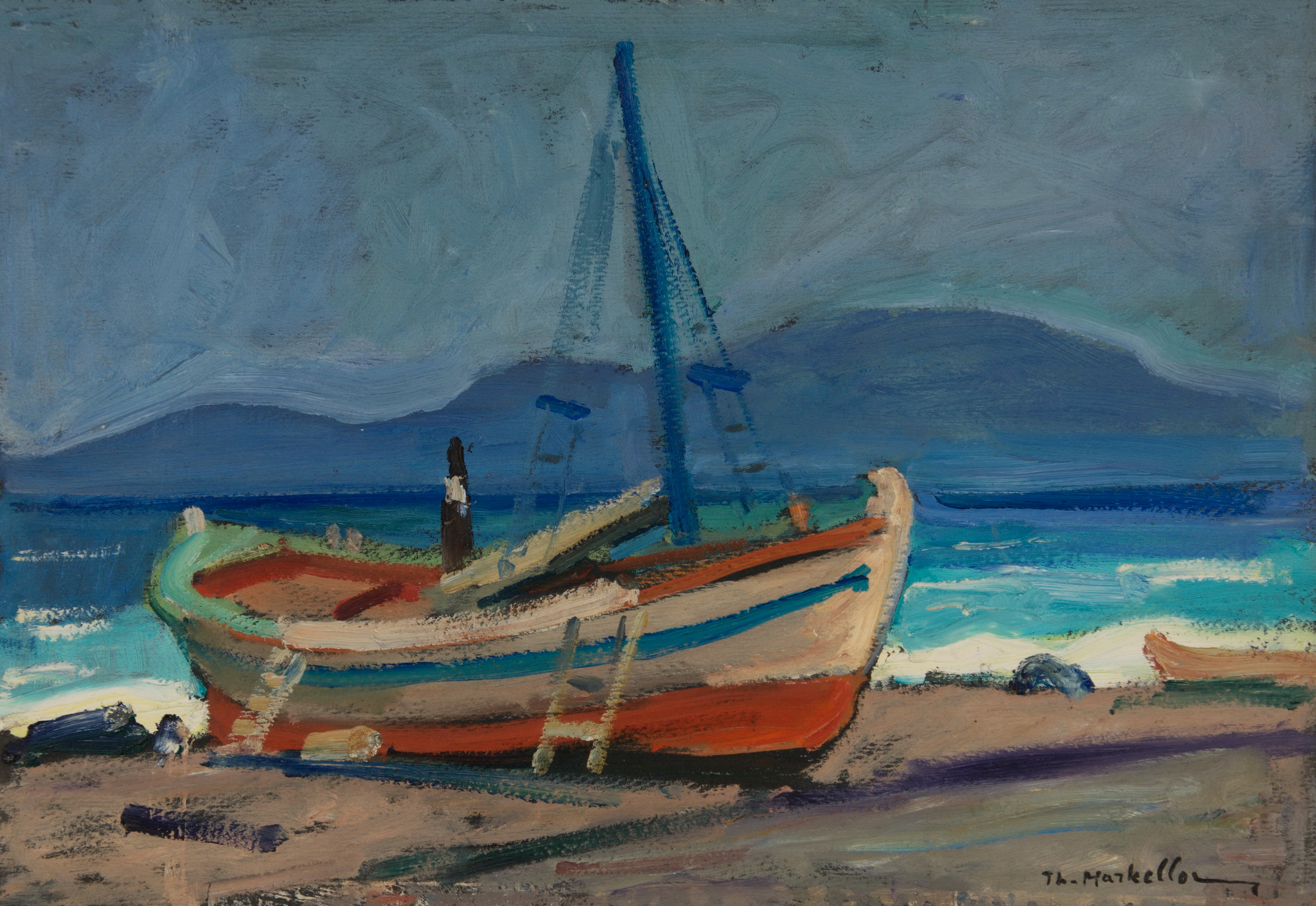
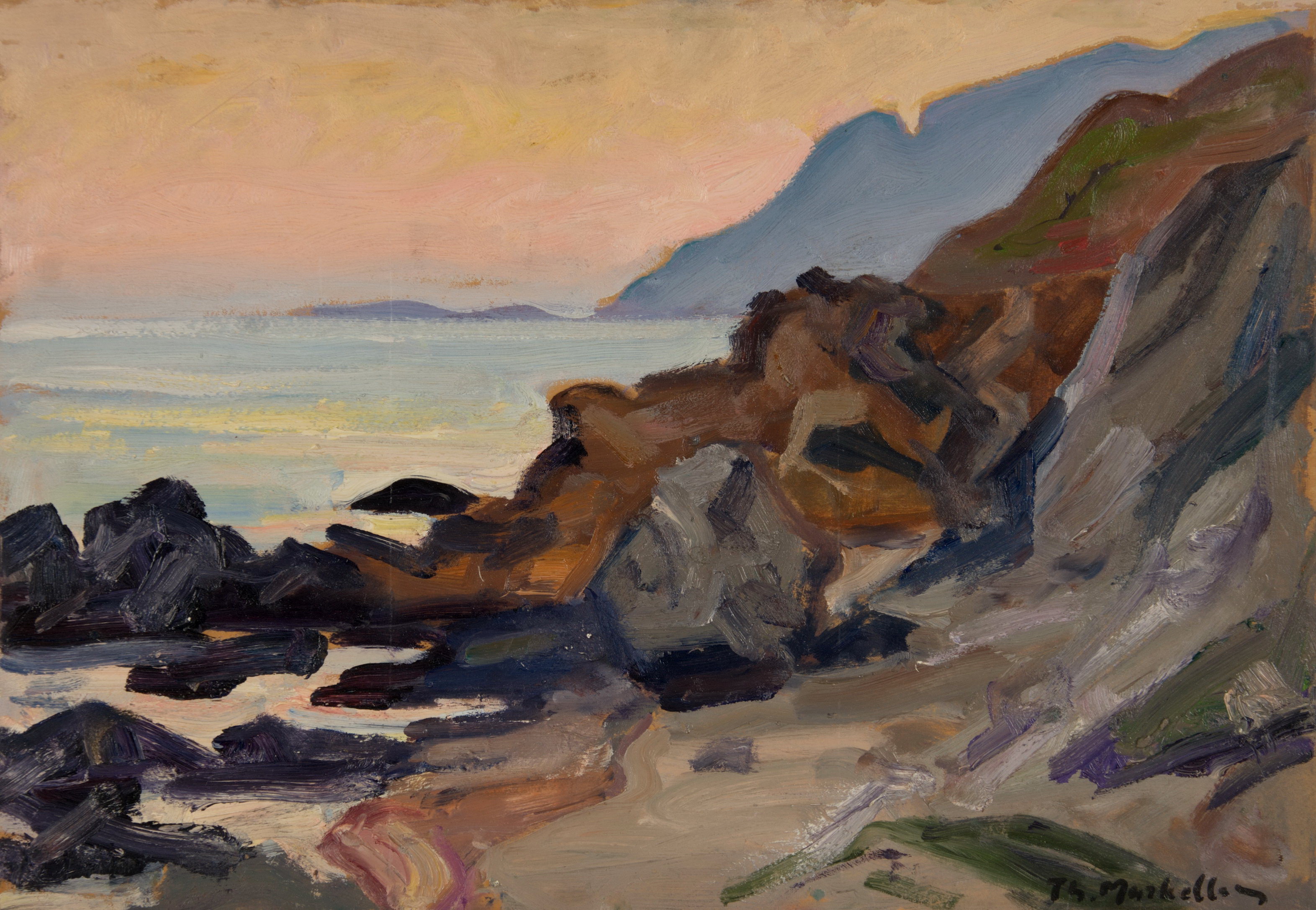
A single caïque holds the silence of an entire sea. In Sunset in Kiato (Caïque), Theodoros Markellos reduces the visible world to its barest elements — boat, water, and sky — and finds within that reduction something quietly inexhaustible. The light does not merely illuminate; it saturates, pressing warmth into every ripple of the water below.
The Painting — Sunset in Kiato (Caïque)
The composition is horizontal and unhurried, organized along a low horizon line that grants the sky generous dominion over the scene. A traditional Greek caïque sits slightly off-center, its dark silhouette crisp and deliberate against the luminous backdrop of a setting sun. There are no figures aboard, no secondary vessels competing for attention — only the boat itself, elemental and self-contained, floating on a surface that mirrors the warmth overhead.
The palette moves through saturated oranges and deep, muted violets toward the cooler blues that gather at the picture's edges, suggesting the slow encroachment of evening. Markellos works these transitions with a wet-on-wet approach that softens the boundary between sea and atmosphere, allowing one to bleed gently into the other. The water below is rendered in subtle, horizontal strokes that evoke ripple and reflection without becoming busy — a reflective plane that deepens the sense of space rather than interrupting it.
Painted in oil on fiberboard, the work demonstrates the particular qualities that surface lends to the hand: broad, fluid sweeps across sky and water give way to tighter, more considered passages along the hull of the caïque, where the structural silhouette demands a steadier touch. Tonal gradation across the upper two-thirds of the composition gives the impression of atmosphere receding into itself — a kind of atmospheric perspective achieved not through diminishing scale but through the gradual cooling and quieting of color. The overall effect is one of lyrical restraint: expressive, but never overworked.
A Painter of Atmosphere and Place
Theodoros Markellos lived and worked from 1925 to 2015, spending the greater part of his career based in Athens. Across a body of work that spans some 750 paintings, he returned persistently to the representational — to landscapes, coastlines, harbors, and the particularities of Mediterranean light — at a moment when much of the art world around him was moving toward abstraction, decoration, or geometric formalism.
Among his Greek contemporaries, the contrast is legible. Where painters like Fassianos pursued flat, decorative surfaces, and Moralis moved toward geometric abstraction, Markellos remained committed to the volumetric and the atmospheric — to the idea that a sky has depth, that water holds color, that a single boat on open water can constitute a complete visual statement. His work suggests a painter for whom observation was not a conservative retreat but an active discipline, renewed painting by painting.
Sunset in Kiato (Caïque), painted on a modest fiberboard support measuring 36 by 51 centimeters, belongs to a body of work concerned with the Aegean coast and the vernacular craft of Greek maritime life. The caïque — a traditional wooden fishing and transport vessel — appears here not as a documentary subject but as a formal anchor: a dark shape that gives the eye somewhere to rest within an otherwise expansive field of light and water. Its silhouette is unambiguous, almost graphic, yet it sits within an atmosphere so warm and enveloping that it never reads as stark or isolated.
To learn more about the full scope of his career, visit the Theodoros Markellos biography.
Looking Closer — The Silhouette and Its Reflection
What rewards sustained attention in this painting is the relationship between the caïque's silhouette and its counterpart in the water below. The hull and mast read as a single dark form against the luminous sky — sharp-edged, almost graphic in its clarity — while the reflection beneath fragments and softens, broken by the gentle horizontal brushwork that describes the sea's surface.
This tension between definition and dissolution is aesthetically central to the work. The boat above is fixed, certain, structural; the boat below is suggestion, mood, light caught and scattered. Markellos does not resolve this contrast so much as hold it in productive suspension, allowing the eye to move between solidity and flux. The compositional balance this creates is quietly sophisticated: the darker tonal weight of hull and mast pulls against the upward luminosity of the sunset, keeping the image grounded without heaviness. It is in this interplay — the precise above, the dissolved below — that the painting earns its emotional register.
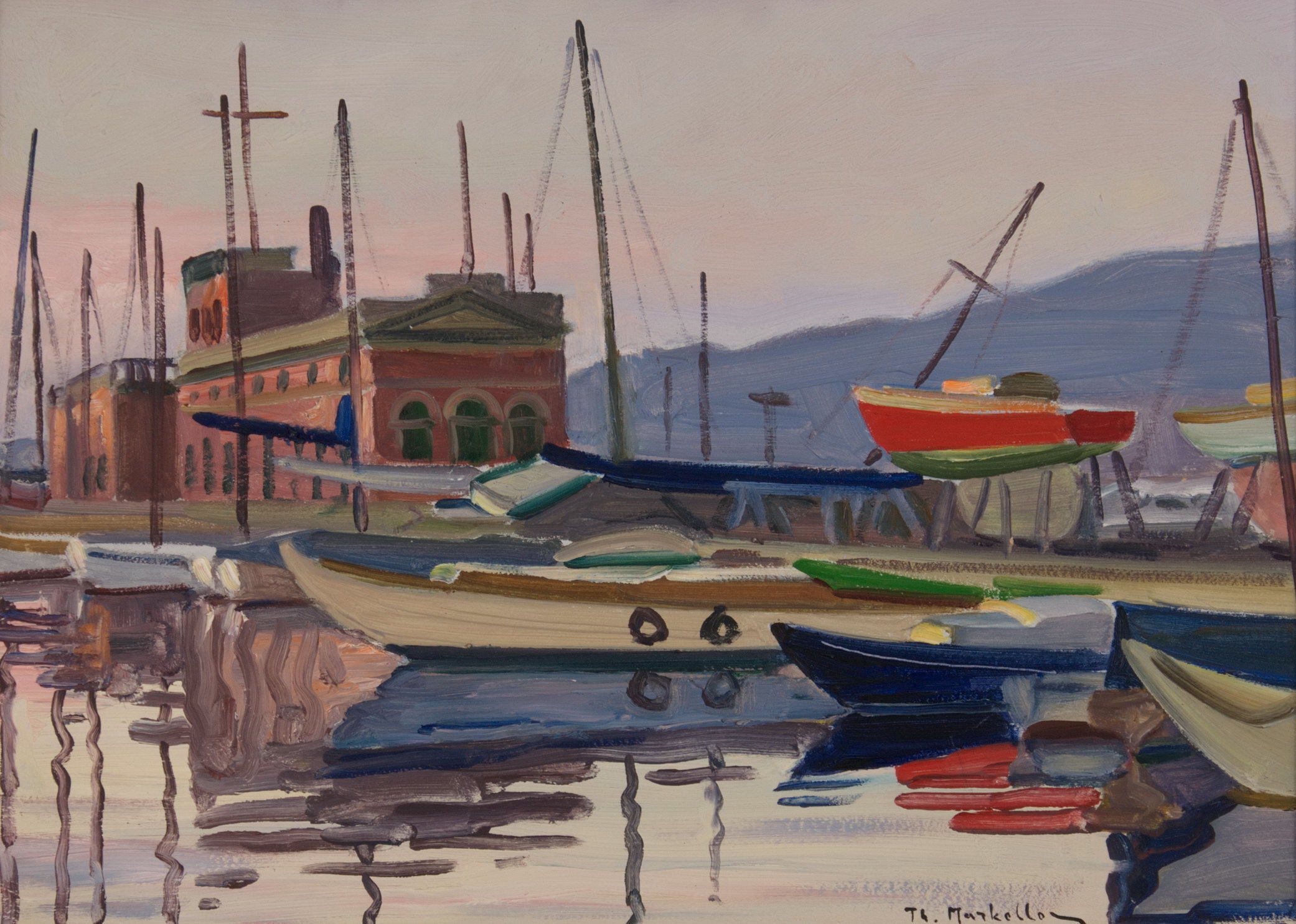
See related works in the full painting gallery, or view a companion seascape, Sunset at the Harbor, which develops similar preoccupations with water, light, and vessel.
About Theodoros Markellos
Theodoros Markellos (1925–2015) was an Athens-based Greek painter whose career spanned more than six decades and produced a catalogue of approximately 750 works. Working primarily in oil on surfaces including canvas, fiberboard, and cardboard, he developed a practice rooted in observational painting — attentive to light, atmosphere, and the specific character of the Mediterranean world. His approach combined the directness of plein air observation with a more considered painterly refinement, resulting in work that is at once immediate and sustained. He remains one of the significant representational painters of twentieth-century Greek art, committed across his long career to the discipline of seeing.
Sunset in Kiato (Caïque) stays with you not for drama or complexity, but for what it chooses to leave out — the crowd, the narrative, the noise. What remains is light meeting water, a single vessel, and the particular quality of silence that falls just before dark. That sufficiency is the painting's quiet argument: that a small fiberboard panel, worked with care and chromatic intelligence, can hold a whole hour of the day.