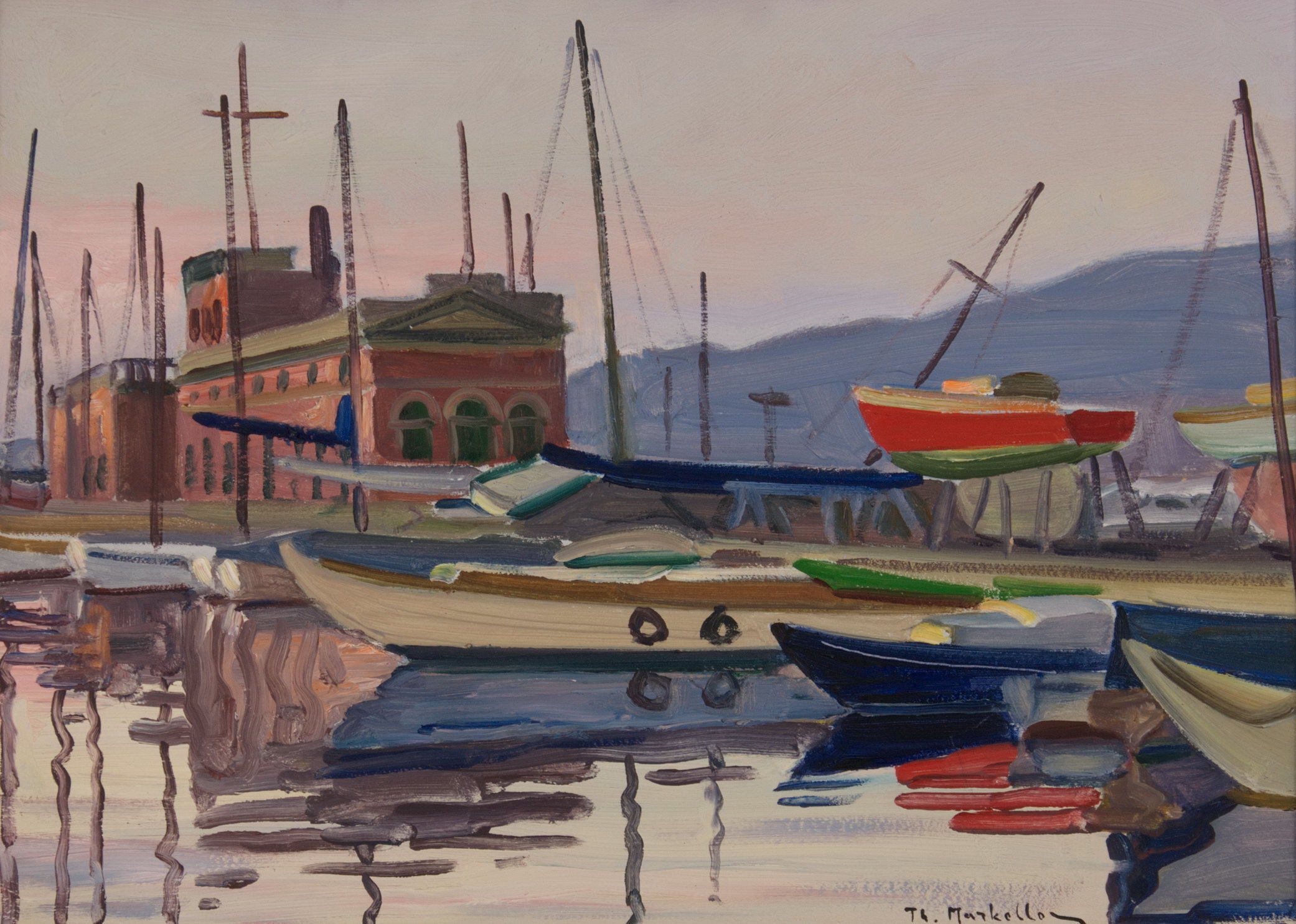
A harbor holds its breath in Theodoros Markellos's Trieste Boats in the Harbor. Moored vessels sit low and still against the quay, their hulls solid and weathered, while masts and rigging draw quiet diagonals across a wide, diffuse sky. No figure moves on any deck; no rope strains against a current.
The Painting — Trieste Boats in the Harbor
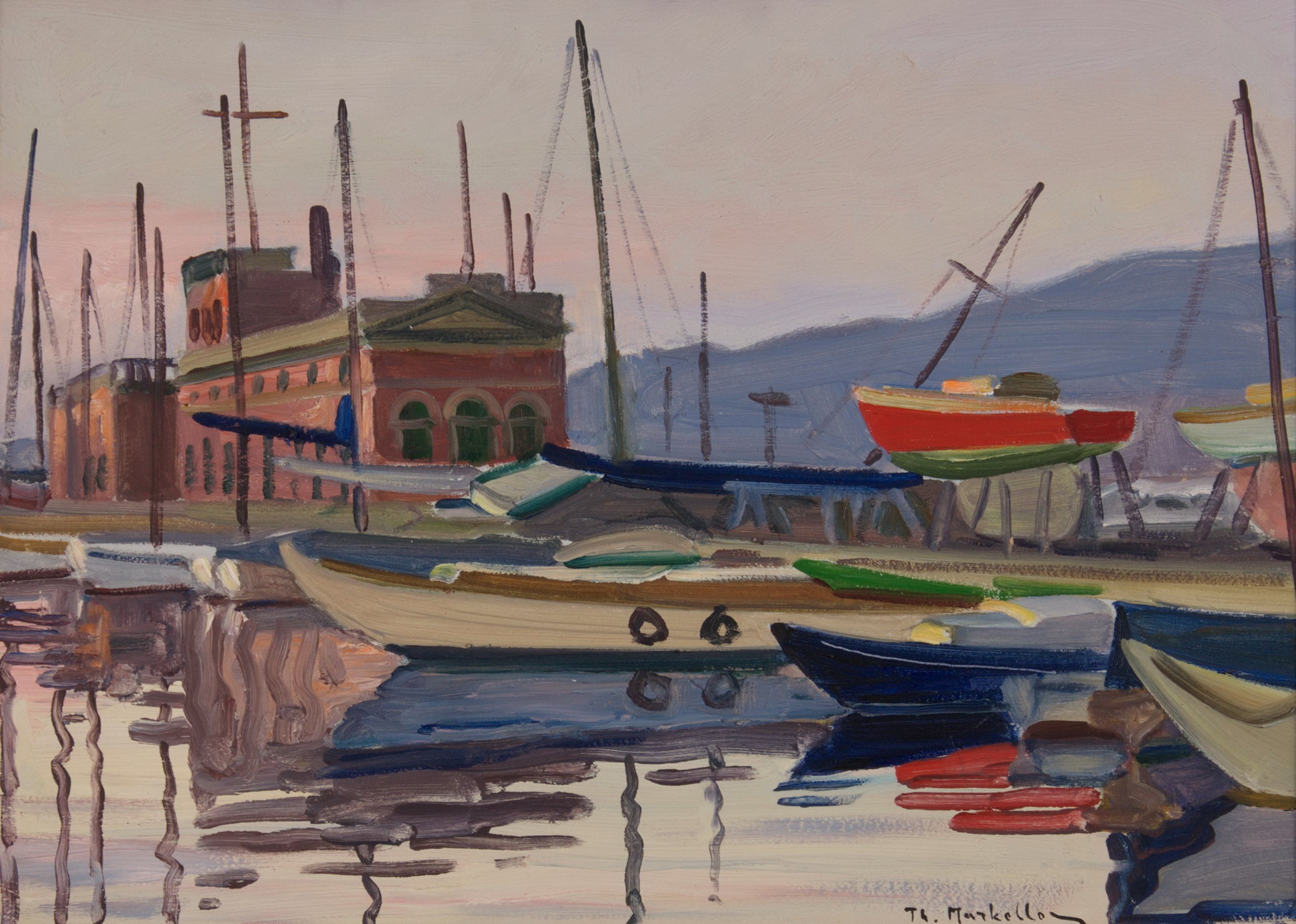
The composition divides itself with quiet authority. The lower third holds the boats — their hulls rendered with simplified yet volumetric forms, sitting heavy and grounded against the horizontal band of quay and water. Above them, two-thirds of the canvas open to sky and the indistinct architectural silhouettes of a waterfront, neither fully resolved nor entirely abstracted. It is the kind of proportion that gives a painting room to breathe.
Masts and rigging rise and cross diagonally through that open space, introducing a measured dynamism against the dominant horizontals of water, dock, and roofline. The effect is subtle: enough movement to keep the eye traveling, not enough to break the prevailing stillness. Decks are empty. Ropes hang slack. The scene suggests a pause between departures rather than abandonment.
Light is diffuse throughout — neither the hard glare of midday nor the warmth of late afternoon, but something softer and less committed to a single hour. Soft shadows affirm volume without dramatizing it. The palette works in saturated but naturalistic tones: ochres, slate blues, warm greys, each modulated carefully so that the luminosity the work evokes feels observed rather than imagined.
Technically, the surface rewards attention. Sky areas are worked more thinly, allowing the paint to breathe and the atmosphere to diffuse. The boat hulls, by contrast, receive denser impasto, building a sense of weathered mass and physical weight. The brushwork throughout is energetic yet controlled — forms are built through layered strokes rather than precise delineation. The canvas retains the immediacy of direct observation while maintaining structural coherence.
Atmosphere as Subject — The Harbor in Stillness
Theodoros Markellos was born in 1925 and died in 2015, spending the greater part of his working life based in Athens. Over a career that produced some 750 works, he returned again and again to harbors, coastlines, and open water — not as picturesque backdrops but as subjects in their own right, capable of holding atmosphere the way a room holds air.
Trieste Boats in the Harbor belongs to that sustained inquiry. The scene is devoid of human presence, and that absence is not incidental. Empty decks and slack rigging suggest time suspended rather than time passing — a harbor between its own moments of activity. The chromatic choices reinforce this register: the palette is neither somber nor festive, but pitched somewhere between, in the range of reflective pause.
What makes the work characteristic of Markellos's approach is its prioritization of atmosphere over anecdote. There is no narrative here, no figure to carry meaning, no dramatic weather event to resolve. The painting asks the viewer to attend to light, structure, and the particular quality of stillness that bodies of water and moored vessels generate together. For an artist working across a career of this length and breadth, that commitment to the affective possibilities of observed place — rather than its symbolic or illustrative uses — represents a consistent and considered aesthetic choice.
The range and consistency of that choice becomes apparent when Trieste Boats in the Harbor is placed alongside Markellos's other coastal and harbor subjects, available across the full gallery collection.
Looking Closer — The Diagonal Rigging
The masts and rigging in Trieste Boats in the Harbor deserve particular attention. In a composition organized predominantly around horizontal bands — water, quay, roofline, sky — the diagonals of the rigging introduce the only sustained countermovement. They are not emphatic. They do not compete with the prevailing stillness. But they prevent the painting from settling into pure repose.
Aesthetically, this is careful compositional management. The rigging creates gentle tonal variation against the sky, its lines reading as both structural elements within the depicted scene and as marks within the painted surface itself. They remind the viewer, quietly, that these vessels are working objects — capable of motion, currently at rest. The tension between that latent energy and the surrounding quietude is where much of the painting's emotional charge resides. It is not stated; it is structured.
This approach — using observed architectural or mechanical detail to carry compositional and affective weight — reflects a sensibility that trusts the visible world to supply meaning without embellishment. Markellos captures exactly as much as the scene requires, and nothing more.
For a related work that shares this compositional attentiveness to harbor structure and coastal light, see Markellos's other maritime paintings held in the collection.
About Theodoros Markellos
Theodoros Markellos (1925–2015) was an Athens-based Greek painter who worked primarily in oil on canvas and related surfaces. Over a career spanning several decades, he produced a body of work numbering approximately 750 paintings, with sustained attention to landscapes, harbors, and coastal subjects. His practice is characterized by energetic brushwork, sensitivity to Mediterranean light, and a representational approach that consistently prioritizes atmosphere and volume over anecdote or illustration. A full account of his life and practice is available on the artist biography page.
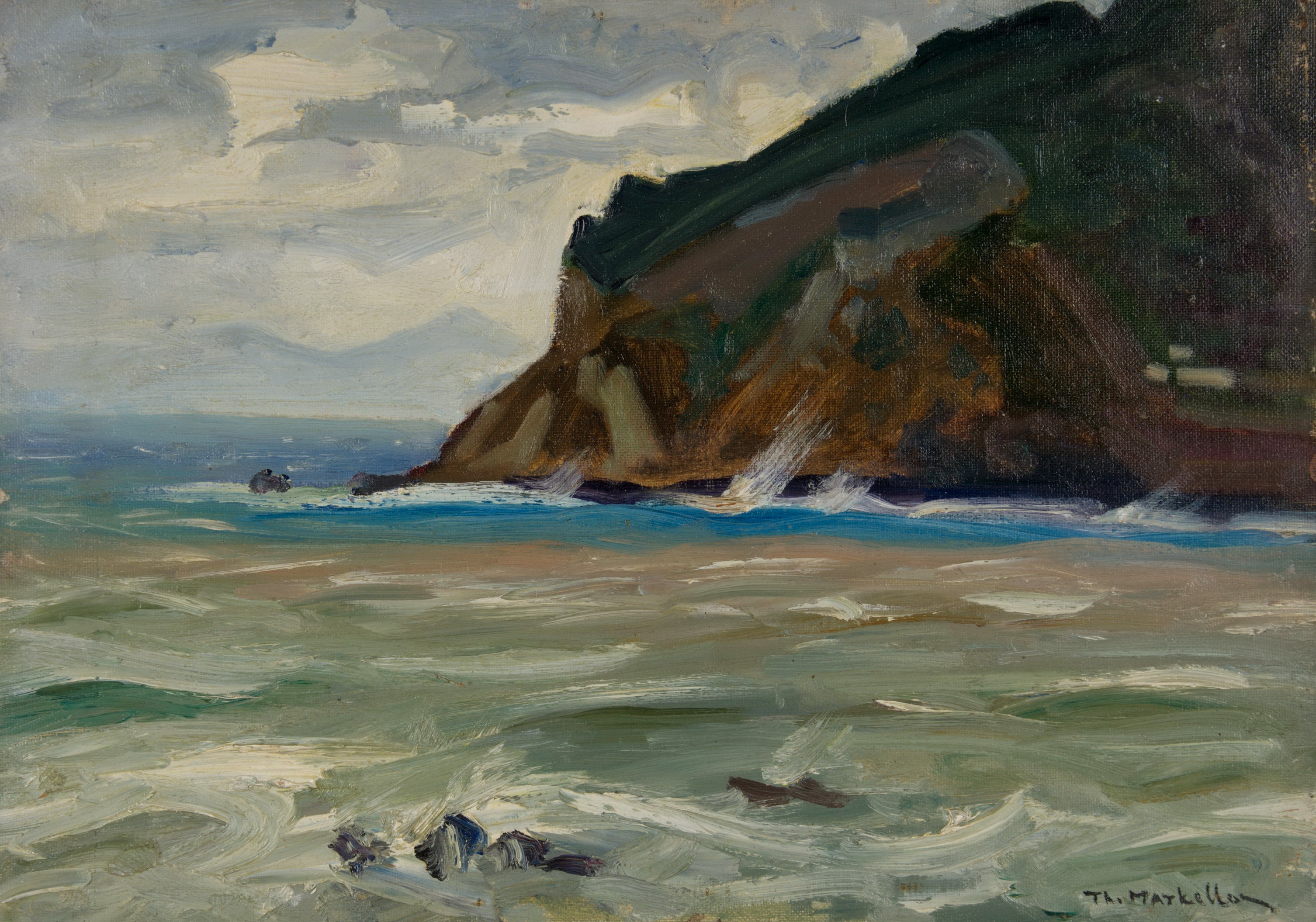
Trieste Boats in the Harbor is a small painting — 37 by 51 centimeters — and that intimacy of scale feels entirely appropriate to what it offers. The boats sit in their harbor, the sky diffuses its pale light across two-thirds of the canvas, and the rigging holds its diagonal tension against the surrounding stillness. Markellos captures the harbor not as a place of arrival or departure, but as a place simply, and sufficiently, at rest.
.jpg)