
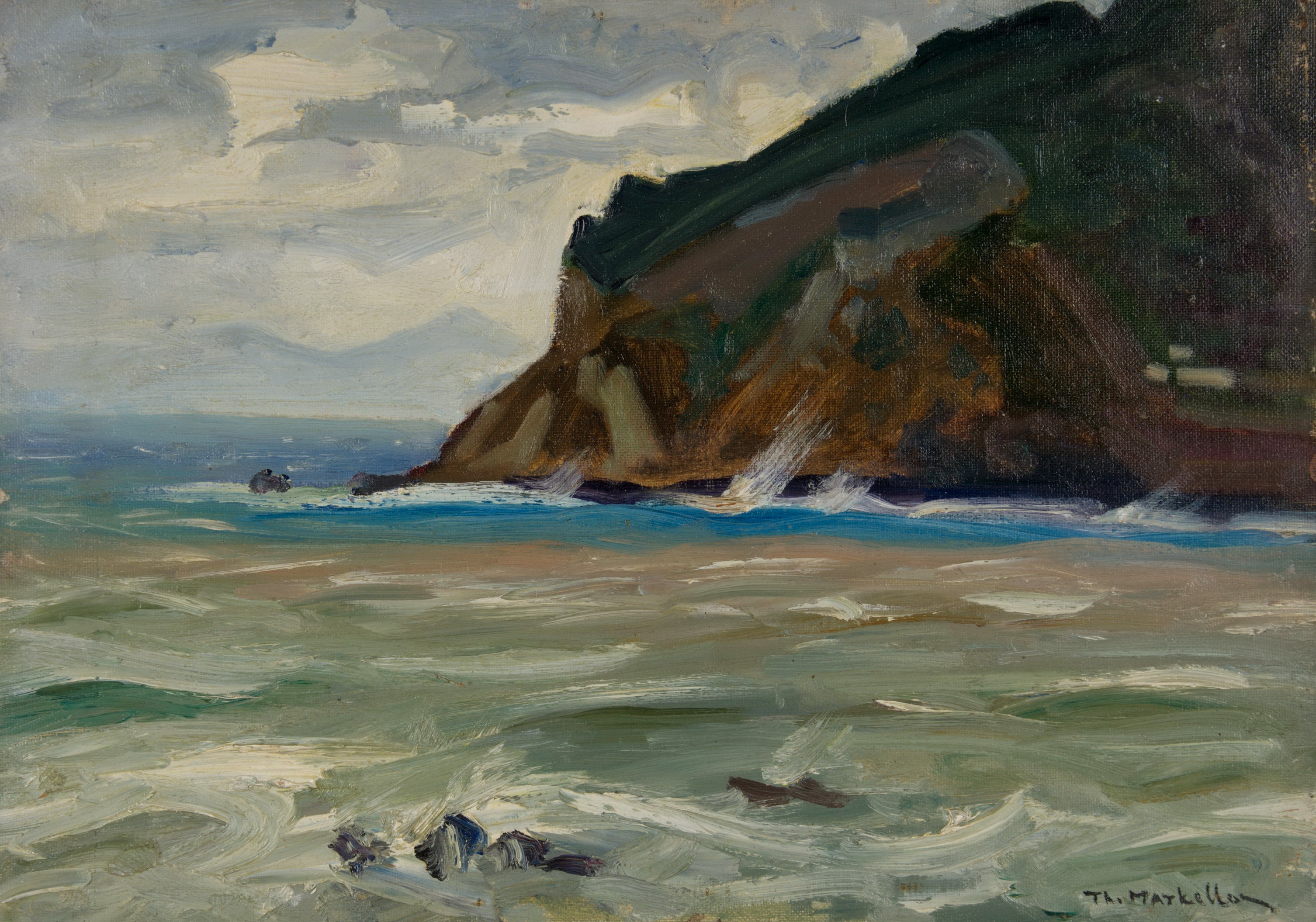
The Painting — Stormy Beach, Nerantza
At just 30×50 centimetres, Stormy Beach, Nerantza works in the horizontal register of the seascape tradition, stretching the eye across a windswept coastal scene that feels considerably larger than its dimensions suggest. A low horizon line — set well beneath the midpoint of the canvas — gives the storm-charged sky the greater share of the picture plane. Cloud masses press downward in broad, directional strokes, their weight rendered in layered tones of slate grey and cool blue that shift, almost imperceptibly, toward warmer ochre at the edges where light still filters through.
The foreground is animated by wet sand and dark, wave-worn rocks. Diagonal wave crests move toward a vanishing point at the right, creating a sense of recession that draws the gaze into the painting's depths without ever arriving at rest. The atmospheric perspective is handled through tonal modulation rather than sharp contour: forms soften as they approach the horizon, while the foreground retains a tactile immediacy. Short, loaded brushstrokes articulate the foam — a technique that suggests impasto work at the water's edge, where the paint surface visibly carries the energy of the gesture.
No human figure appears. The landscape does not frame a story; it simply is. The palette throughout favours saturated blues and greys against the pale luminosity of diffused coastal light, a chromatic relationship that evokes neither full storm nor full calm but something poised between the two. The brushwork varies meaningfully: broader sweeps define the sky and open sea, while shorter, more pressured marks give the foreground rocks and surf their density. The overall surface retains the directness associated with plein air practice, yet the tonal harmonies suggest a considered compositional hand at work behind the apparent spontaneity.
More coastal and seascape works can be found in the Markellos gallery, or view the related work Stormy Sea, which develops similar atmospheric concerns across a larger format.
Observation and the Aegean Coast
Theodoros Markellos was born in 1925 and spent his working life based in Athens, where he developed a practice rooted in direct observation of Mediterranean light and terrain. Over a career that extended to his death in 2015, he produced more than 750 works — a body of output remarkable not only for its scale but for its consistency of purpose. Throughout, he returned to the natural world as primary subject: coastlines, harbours, skies, and water in their many seasonal and atmospheric states.
What characterises Markellos within the broader landscape of twentieth-century Greek painting is his sustained commitment to the representational and the atmospheric. Where some contemporaries moved toward decorative flatness or geometric abstraction, his canvases remained anchored in observed reality while absorbing the expressive colour possibilities that European modernism had made available. The result is a style that occupies a productive space between the documentary and the lyrical — neither strictly one nor the other, but drawing credibly on both.
Stormy Beach, Nerantza sits comfortably within this approach. The Aegean coast offers particular conditions — the quality of light under overcast skies, the specific grey-blues of unsettled water, the way diffused illumination falls on wet sand without casting strong shadow — that the painting registers with evident attentiveness. The work suggests a painter who found in the coastal landscape not merely a picturesque subject but a genuine vehicle for tracking the relationship between light, atmosphere, and mood. The site is not idealised or exoticised; it is observed, steadily and without sentimentality.
Learn more about the artist's life and practice on the Markellos biography page.
Looking Closer — The Foam at the Wave's Edge
Among the painting's most quietly compelling passages is the treatment of the breaking foam in the foreground. Here, where sea meets sand, Markellos shifts his touch. The broader, more fluid strokes that define the open sky and mid-ground water give way to shorter, more pressured marks — paint applied with a confidence that leaves the gesture visible on the surface. The result is a zone of the canvas that reads differently from the rest: denser, more tactile, more immediate.
This variation in brushwork is not merely technical; it is compositional. The froth and foam anchor the viewer to the near shore, providing a foreground presence that prevents the vast sky and open sea from dissolving into pure atmosphere. The impasto touches at the water's edge carry a different quality of light — not the diffused luminosity of the storm sky, but the brief, sharp brightness of broken water catching whatever illumination filters through the clouds. It is a small decision with significant consequences: it holds the painting's spatial logic together, binding the intimate foreground to the immense distance behind it, and giving the eye a place to rest before moving outward again.
About Theodoros Markellos
Theodoros Markellos (1925–2015) was an Athens-based Greek painter who worked primarily in oil on canvas throughout a career spanning several decades. He is represented by a catalogue of more than 750 works, ranging from small-format coastal studies to larger compositional paintings. His practice centred on direct observation of the natural world, with a particular focus on Mediterranean light, water, and atmosphere. Markellos maintained a commitment to representational painting throughout a period when abstraction dominated much of the wider art world, developing a style that brought expressive and lyrical qualities to bear on closely observed subjects. His work is held in private collections. Read more on the artist biography page.
Stormy Beach, Nerantza does not demand interpretation so much as it rewards patience — the kind of looking that allows a thirty-by-fifty centimetre canvas to expand into something that feels genuinely wide and genuinely unsettled. The painting's authority lies in its restraint: no drama manufactured, no figure added to supply scale or narrative, no concession to the picturesque. What remains when all of that is withheld is light on water, cloud on sky, and the quiet conviction of a painter who trusted the scene — exactly as it was — to be enough.
.jpg)